

Approval Doesn't Equal Delivery
The Week Housing Policy Met Market Reality

This week’s housing story was not one headline.
It was a contradiction.
Rates are rising.
Approvals are falling.
Investors are still borrowing.
Battery uptake is surging.
Governments are still promising housing supply.
On paper, Australia is trying to build its way out of the housing crisis.
In reality?
The market is asking a much harder question: can these projects actually be delivered?
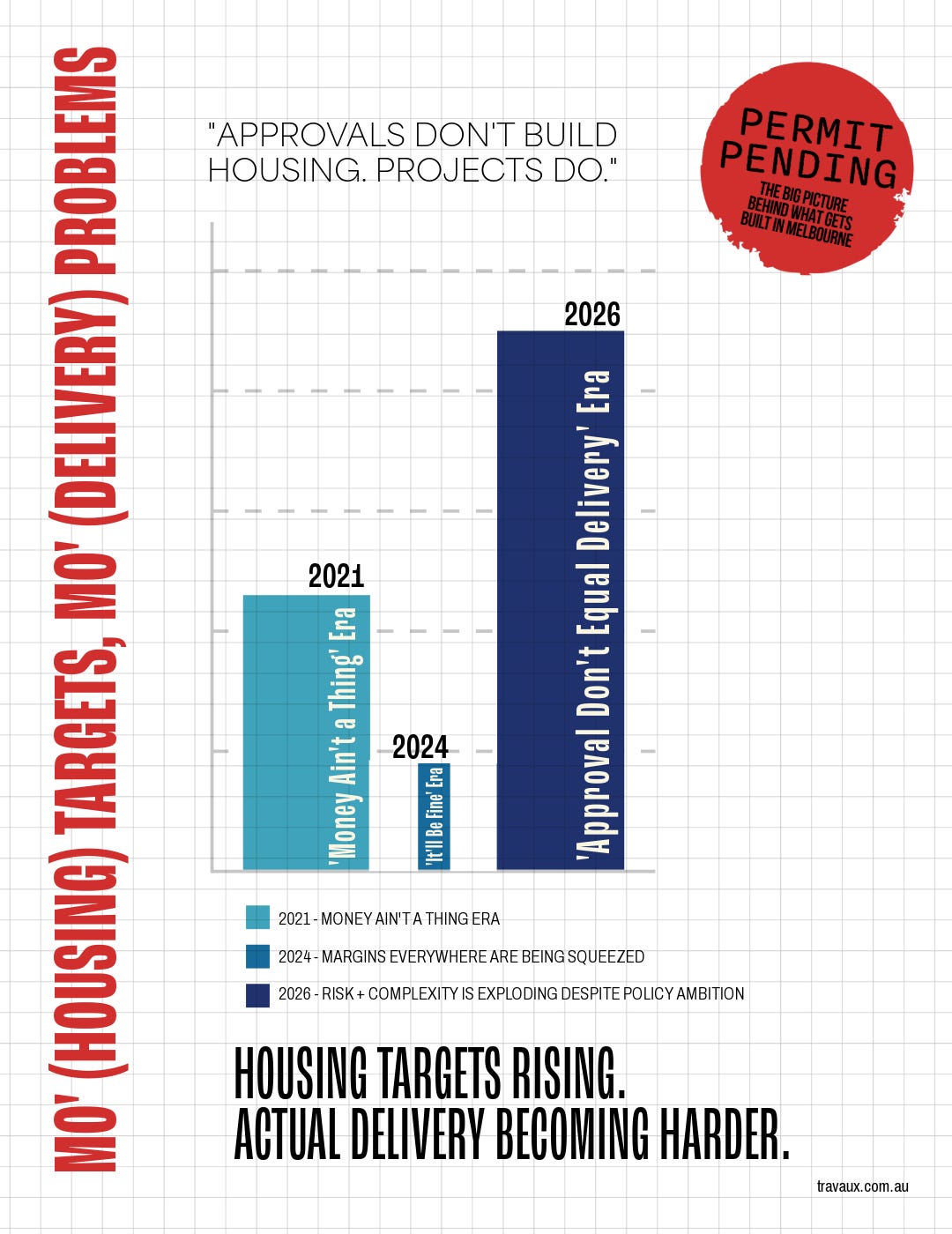
Australia doesn’t just have a housing shortage
It has a delivery mismatch.
This week, building approval data showed a familiar pattern emerging again: detached houses held up reasonably well, while unit approvals softened sharply.
And that matters.
Because the exact housing typologies governments are now aggressively pushing - apartments, density, infill and higher-yield projects - are also the projects under the most financial pressure.
Not because people don’t need housing.
But because:
construction costs remain elevated
debt is expensive
infrastructure competition is tightening labour
buyer confidence is selective
and exit risk is becoming harder to ignore
Approval does not automatically equal delivery.
That’s the gap the industry keeps running into.
Rates are no longer just a borrower problem
The latest interest rate rise matters far beyond mortgage repayments.
For developers and project teams, rates now affect:
acquisition assumptions
holding costs
debt servicing
buyer borrowing capacity
sales velocity
and overall project risk
The market is no longer reacting to rates emotionally.
It is reacting structurally.
A rate rise now changes:
what sites are worth
what products are viable
and whether projects proceed at all
That is a completely different phase of the cycle.
The market isn’t collapsing. It’s splitting.
One of the more interesting signals this week was the contrast between:
stronger investor borrowing activity
and softer broader buyer sentiment
This is not a uniform market anymore.
Sophisticated investors and better-capitalised players are still moving.
But the middle is tightening.
Clearance rates remain softer. Buyers are more selective. Lending buffers matter more. Product mismatch is being punished faster.
The market has not stopped.
It has become far less forgiving.
This is not a crash story.
It is a selectivity story.
Energy is quietly becoming a development issue
One of the less discussed stories this week was the acceleration in battery uptake and renewable infrastructure investment.
At first glance, this feels disconnected from housing.
It isn’t.
Energy resilience is increasingly becoming:
a buyer consideration
a construction consideration
and eventually, a feasibility consideration
Battery rebates continue to accelerate uptake, while major players like Amazon are signing enormous renewable and storage agreements to secure long-term energy reliability for Australian operations.
That matters because:
power pricing volatility affects operating costs
infrastructure demand affects construction inputs
and energy resilience increasingly influences buyer expectations
The next phase of residential development is not just about density.
It is increasingly about:
resilience, efficiency and operational certainty.
Melbourne is entering a more disciplined phase
Melbourne’s market still has long-term structural demand:
population growth
migration
undersupply
infrastructure investment
None of that disappears overnight.
But the market is clearly becoming more disciplined.
Projects that still work are generally:
well located
tightly designed
commercially realistic
aligned to actual buyer demand
The era of relying on endless uplift, aggressive assumptions or “the market will catch up later” thinking is fading.
And honestly?
That may not be a bad thing.
Where this hits your project
Acquisition
Rates and softer buyer sentiment are changing what sites are worth and what risks the market will tolerate.
Planning
Approvals alone are no longer enough. The project still needs to stack under current market conditions.
Design
Product-market fit matters more than ever. Overspecification and poor buyer targeting are becoming expensive mistakes.
Construction
Fuel, labour, infrastructure pressure and energy costs continue feeding uncertainty into delivery assumptions.
Sales & Exit
Buyers still exist - but they are more selective, more constrained and slower to move.
Final thoughts
This week reinforced something the market is slowly starting to understand.
The housing conversation is no longer just about supply.
It is about:
feasibility
timing
delivery risk
infrastructure pressure
buyer capacity
and project resilience
Governments can push targets.
Councils can approve density.
But eventually every project still runs into the same question:
Does it actually work in the real market?
And increasingly, that answer is becoming more complicated.
What are you seeing on the ground?
Are projects becoming harder to deliver - or simply more selective?
Rebecca Lloyd-Jones is a development strategist and founder of Travaux, working across the intersection of planning, construction, market dynamics and project delivery.
Through Permit Pending and Site Intel, she analyses the forces shaping residential development in real time – from interest rates and planning policy through to construction costs, infrastructure pressure and delivery risk – translating them into clear, practical insights across the full project lifecycle.